
ISTC Governing Board Holds 82nd Session
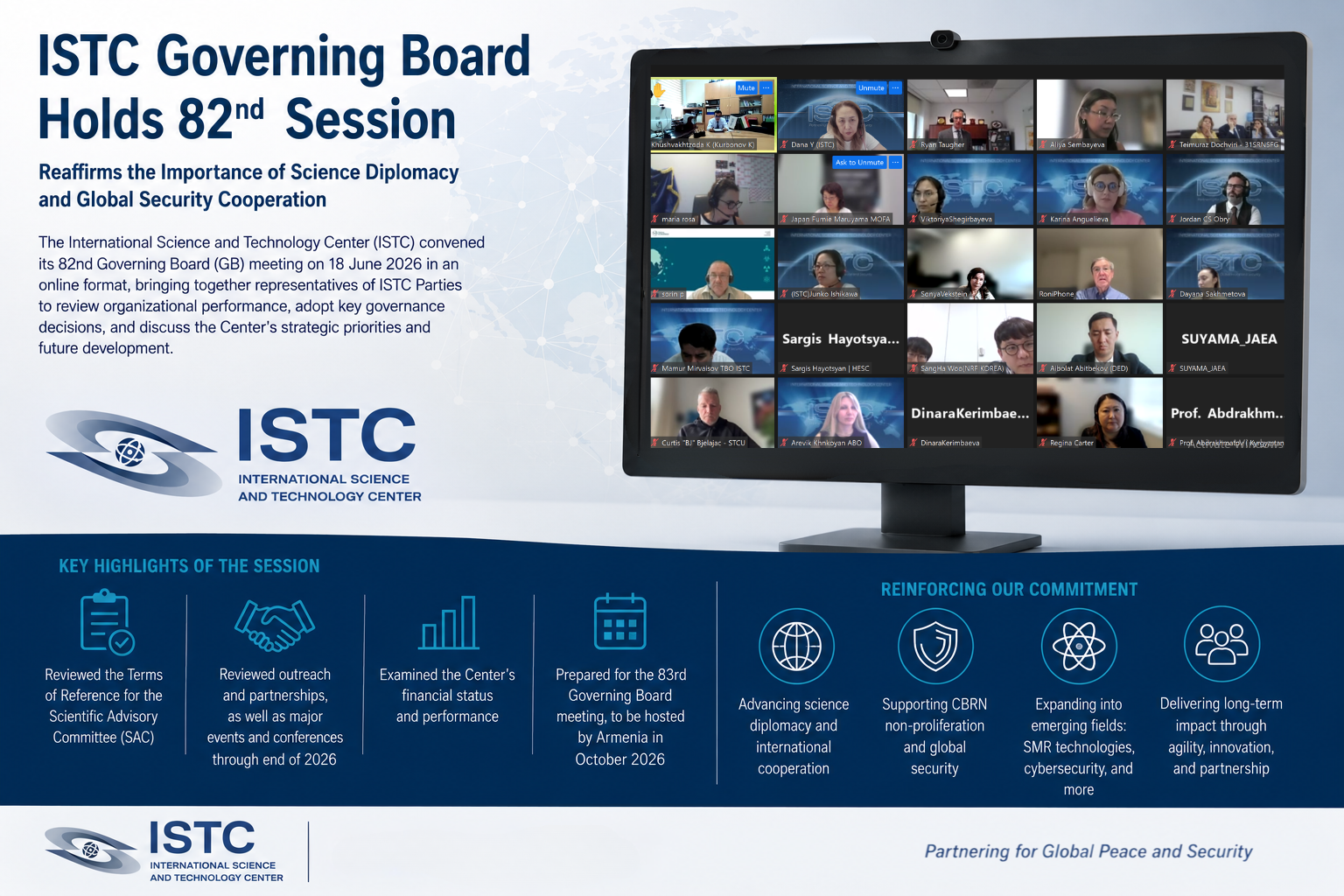
ISTC Governing Board Holds 82nd Session, Reaffirms the Importance of Science Diplomacy and Global Security Cooperation
The International Science and Technology Center (ISTC) convened its 82nd Governing Board (GB) meeting on 18 June 2026 in an online format, bringing together representatives of ISTC Parties to review organizational performance, adopt key governance decisions, and discuss the Center’s strategic priorities and future development. The Governing Board was chaired by Dr. Ronald F. Lehman II.
During the session, the Governing Board considered a broad range of institutional and operational matters, including:
- Review of the Terms of Reference for the Scientific Advisory Committee (SAC), further strengthening ISTC’s commitment to independent scientific advice and oversight;
- Review of outreach and partnership activities, as well as major events and conferences planned through the end of 2026;
- Examination of the Center’s financial status and performance;
- Preparations for the 83rd Governing Board meeting, which will be hosted by Armenia in October 2026.
The discussion also highlighted the evolving role of ISTC in addressing global security challenges through international scientific cooperation. Board members reiterated their recognition of ISTC’s unique model of operation, which promotes knowledge exchange and builds partnerships across regions and geopolitical divides. Through these efforts, ISTC continues to support Chemical, Biological, Radiological and Nuclear (CBRN) non-proliferation objectives while advancing responsible science and technology worldwide.
The Governing Board acknowledged the growing importance of ISTC as an effective science diplomacy platform. Members also emphasized that the Center’s value extends beyond project implementation, serving as a trusted mechanism for fostering dialogue, scientific engagement, and international security collaboration.
The Board further noted ISTC’s expanding role in the Middle East, North Africa and Gulf region, and Southeast Asia, as well as its increasing engagement in new and rapidly developing fields such as small modular reactor (SMR) technologies, cybersecurity, and other security challenges.
Building on the discussions held during the previous Governing Board session, members reaffirmed their strong political support for the ISTC Secretariat, recognizing its operational excellence, efficiency, and ability to deliver tangible long-term impact.
Parties underscored that ISTC has evolved beyond its original mandate and continues to demonstrate agility, innovation, and relevance in responding to contemporary international challenges.